
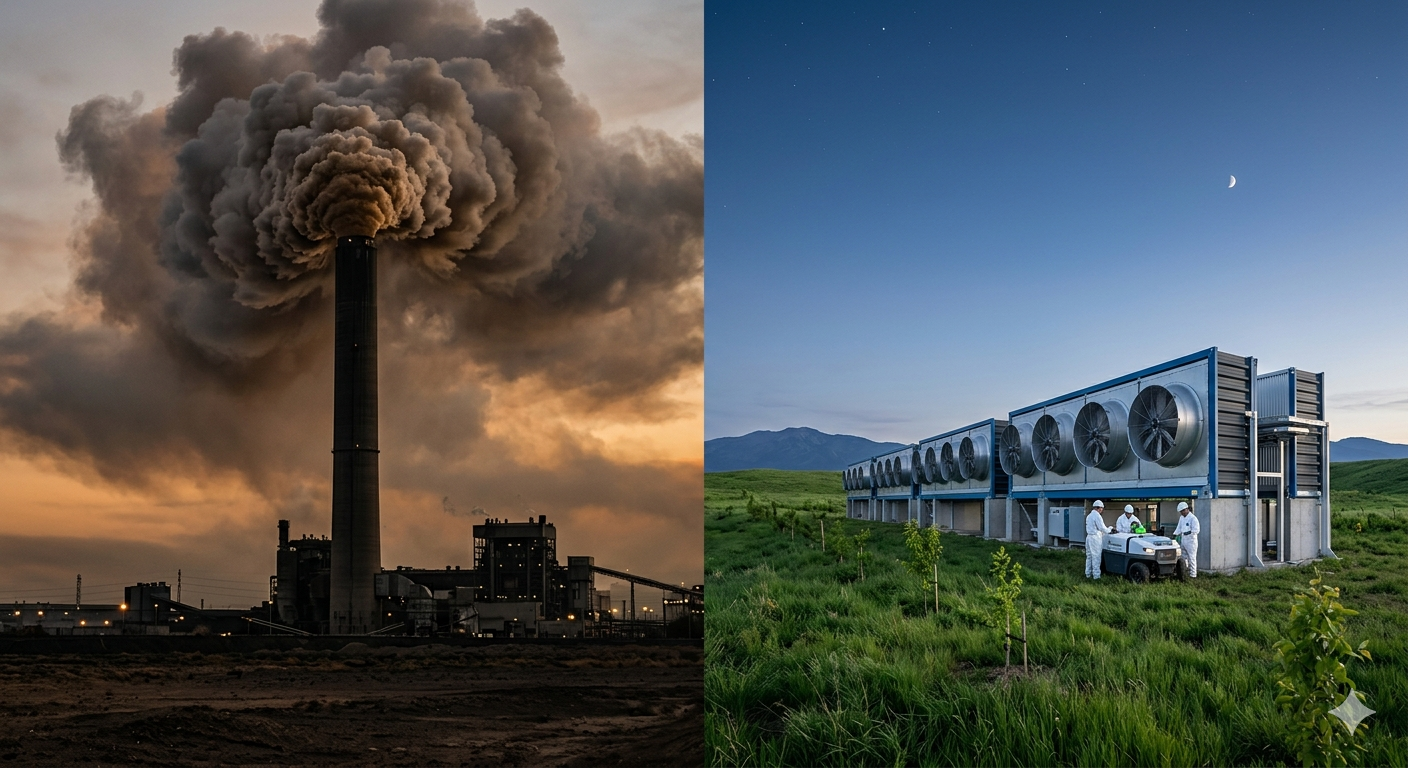
If you have read any major climate news in 2026, you have undoubtedly encountered the phrase “Carbon Sequestration.” With billions of dollars in government subsidies and private investments pouring into the sector, it is frequently hailed as the ultimate technological savior.
The narrative is incredibly tempting: What if we could just vacuum the carbon out of the sky, bury it underground, and continue our lives as usual without having to radically change the global economy?
As with all climate solutions, the reality is far more complex than the headlines. While carbon sequestration is a critical tool in our climate survival kit, it is not the silver bullet it is often marketed to be. Here is a hype-free, scientifically grounded breakdown of how we capture carbon today, and why it cannot replace the hard work of cutting emissions.
What Actually is Carbon Sequestration?
At its most basic level, carbon sequestration is the process of capturing carbon dioxide (CO2) from the atmosphere or from industrial smokestacks, and storing it long-term so it cannot contribute to global warming.
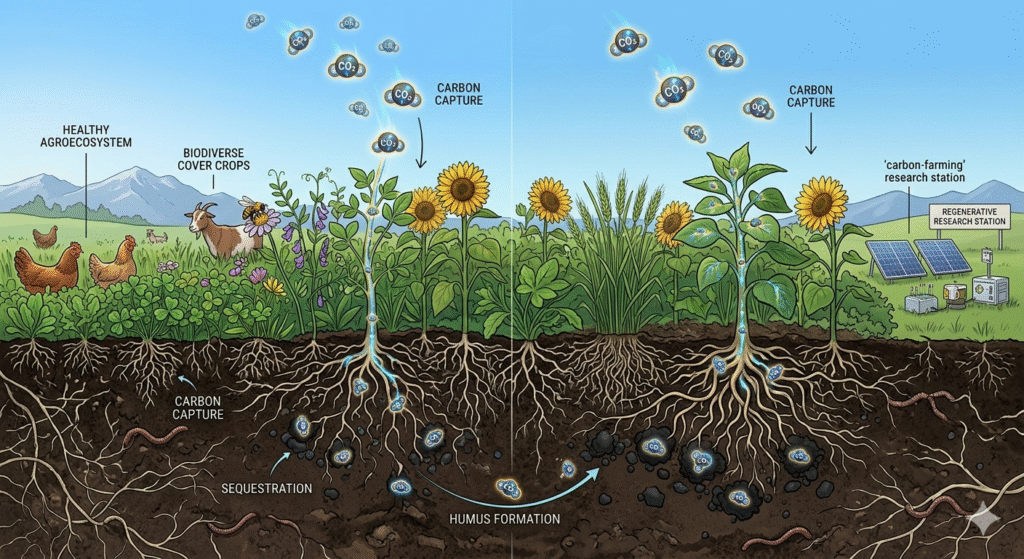
This happens through two entirely different pathways: Biological and Technological. Grouping them together often creates massive consumer confusion, so let’s break them apart.
1. Biological Sequestration: Nature’s Technology
For billions of years, the Earth has perfectly balanced its own carbon cycle using biological sequestration.
- The Oceans: The planet’s largest carbon sink, absorbing about 25% of all CO2 emissions.
- Forests and Peatlands: Trees absorb CO2 during photosynthesis, storing the carbon in their trunks, roots, and the soil.
- Regenerative Agriculture: By changing how we farm—minimizing tilling, planting cover crops, and restoring soil microbiomes—we can turn agricultural land from a carbon emitter into a massive carbon sponge.
The Reality Check: Nature-based solutions are essential, but we cannot simply “plant our way out” of the crisis. There is not enough arable landmass on Earth to plant the number of trees required to offset current fossil fuel emissions. Furthermore, as global temperatures rise, biological sinks become fragile. When a massive forest burns in a wildfire, decades of sequestered carbon are instantly released back into the atmosphere.
2. Technological Sequestration: The Heavy Machinery
When politicians and tech billionaires talk about carbon sequestration, they are usually referring to industrial machinery. This sector is heavily divided into two distinct technologies:
Point-Source Capture (CCUS)
Carbon Capture, Utilization, and Storage (CCUS) involves installing scrubbers directly onto the smokestacks of heavily polluting facilities, like cement factories, steel mills, or coal power plants, capturing the CO2 before it enters the atmosphere.
The Controversy: CCUS is highly controversial in 2026. The International Energy Agency (IEA) recently downgraded its expectations for the technology, noting it will likely contribute less than 5% to offsetting global emissions by 2050. Critics point out that CCUS is incredibly expensive, custom-built for each factory, and frequently fails to meet its capture targets. Worst of all, the fossil fuel industry has historically used captured CO2 for “Enhanced Oil Recovery”—pumping it into depleted oil wells to force more oil out of the ground, entirely defeating the purpose.
Direct Air Capture (DAC)
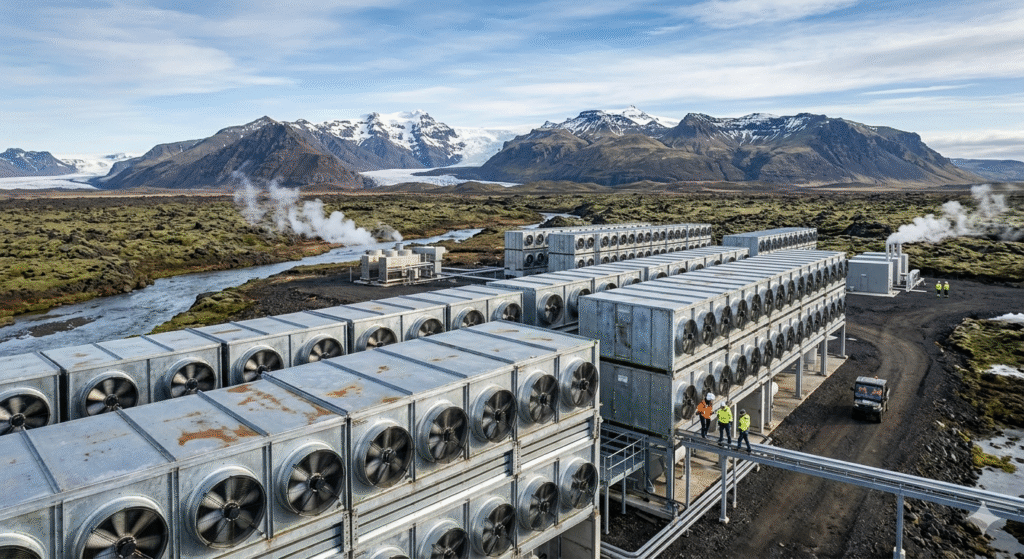
If CCUS is a filter on a smokestack, DAC is a giant vacuum cleaner for the open sky. These massive facilities use giant fans to pull in ambient air, run it over chemical sorbents that bind to the CO2, and extract it to be buried deep underground in rock formations.
The Breakthroughs and Barriers: DAC is the only way to remove historical emissions—the carbon we emitted decades ago that is still heating the planet. We are seeing massive scaling in 2026, with facilities like the STRATOS plant in Texas aiming to capture hundreds of thousands of tons. However, pulling CO2 out of ambient air (where it is highly diluted) requires an astronomical amount of energy. Because of this, DAC remains incredibly expensive, with costs still hovering between $600 and $1,000 per ton of carbon removed.
The Math Problem: Gigatons vs. Megatons
To truly understand the sequestration debate, you have to do the math.
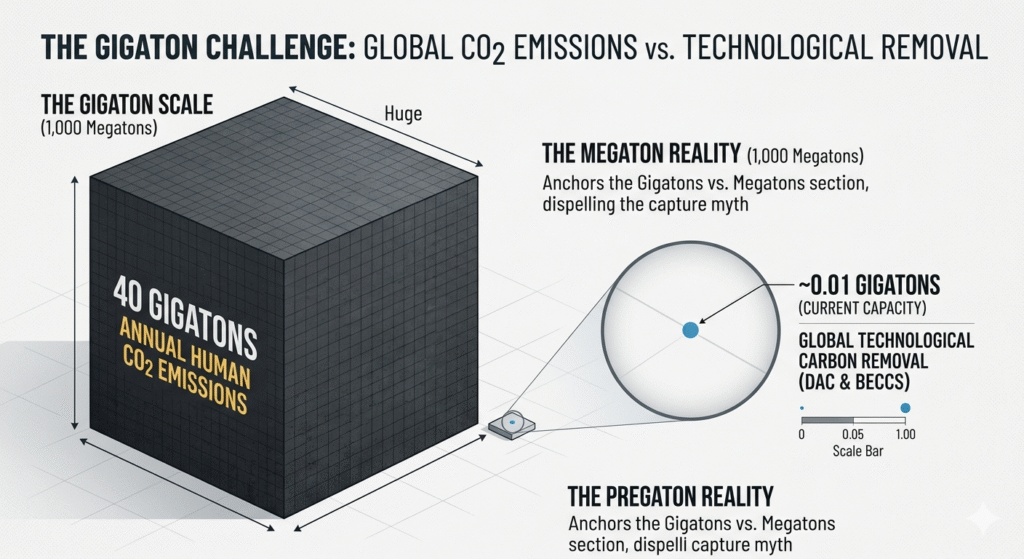
Humanity currently emits roughly 40 billion tons (gigatons) of CO2 every single year.
The largest, most cutting-edge Direct Air Capture facilities operational or scaling up in 2026 measure their success in the thousands or hundreds of thousands of tons. Even if we scale DAC exponentially, it will only scratch the surface of our annual output.
Trying to use technological carbon sequestration to solve our current emission rates is like trying to bail water out of a sinking ship with a teaspoon while refusing to turn off the massive hose flooding the deck.
Conclusion: A Mop, Not a Plug
Does this mean carbon sequestration is a waste of time? Absolutely not. We desperately need it.
Even if we completely transitioned to renewable energy tomorrow, there are certain sectors—like aviation, shipping, and heavy manufacturing—that are incredibly difficult to decarbonize. Furthermore, we have already pumped too much historical carbon into the atmosphere. To stabilize the climate, reaching “net-zero” is not enough; eventually, we must become “carbon-negative.” DAC and nature-based sequestration are the only ways to achieve that.
Carbon sequestration is the mop we will use to clean up the historical mess. But before we can mop the floor, we have to turn off the tap. Deep, immediate, and aggressive reductions in fossil fuel emissions remain the only primary key to reversing climate change.